Premium Space Games for iPhone: Sci-Fi Adventures Without IAP
Premium Space Games for iPhone: Sci-Fi Adventures Without IAP
Space games on iPhone have a problem: most of them are free-to-play with energy timers, battle passes, and dark-pattern monetization baked in. If you want a complete, craft-built space game you can own outright—no ads, no in-app purchases, no grinding between play sessions—the selection gets thin fast. That’s where premium space games come in. These are one-time purchases built by developers who trust their mechanics enough to charge upfront and step back.
This guide covers five space games worth your money: titles that respect the arcade lineage (Asteroids, Lunar Lander, Defender), lean into real physics where it matters, and deliver the kind of polish that signals a developer who cares about the game, not the monetization.
Why Premium Space Games Matter
Free-to-play space games on iOS train you to expect friction: energy systems that gate play sessions, ads that interrupt momentum, and in-app purchases that unlock power creep. Premium games flip that model. You pay once. You own the game. The developer’s incentive shifts from maximizing session time and monetization hooks to shipping something you’ll want to play again.
Space games specifically benefit from this trust. Orbital mechanics, fuel management, and asteroid navigation work best when the player can experiment without timers. Arcade-style space combat—the lineage tracing back to Asteroids and Defender—demands flow state, not interruption. A game designed around a battle pass or daily login bonus fundamentally can’t deliver that.
The five games below represent different flavors of space gameplay, all built with the understanding that a premium price buys you a complete, uncompromised experience.
Galaximus: Real Orbital Mechanics Without Compromise
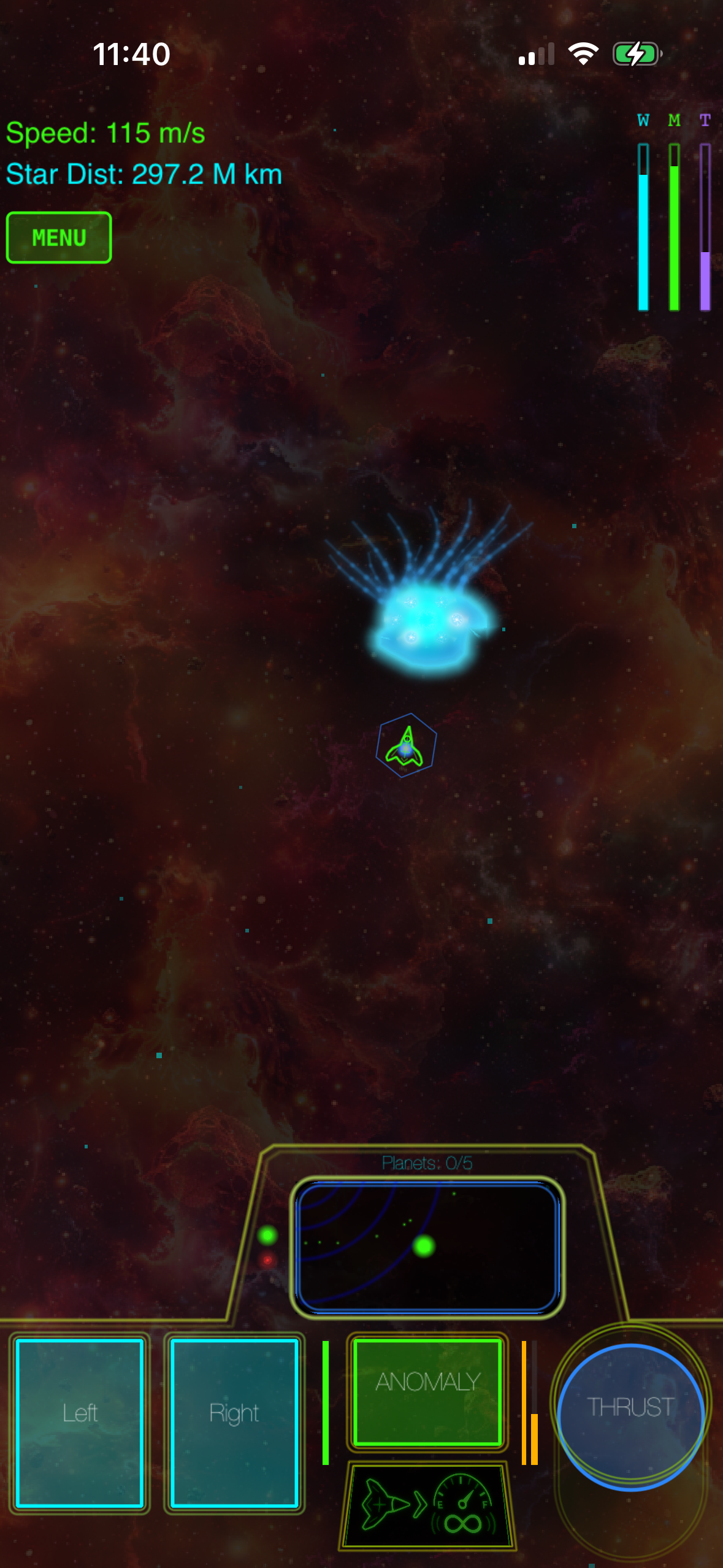
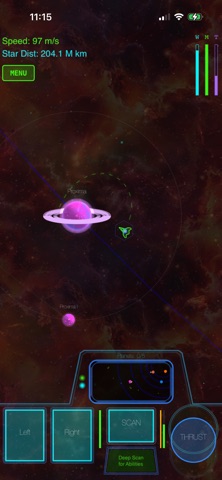
Galaximus leans into something most space games avoid: actual two-body orbital physics. The game doesn’t simplify gravity into a speed boost or a directional push—it models the gravitational pull of nearby planets and moons, meaning your trajectory curves based on mass and distance. That sounds academic until you play it; then it becomes a puzzle of positioning, timing, and patience.
The core loop is simple: navigate your ship to a target, destroy threats, and escape the gravity well. But the execution demands something different from twitch-arcade games. You’re rewarded for understanding momentum, for plotting an approach that uses gravity as a tool rather than fighting it. The game respects the player’s intelligence and doesn’t hold your hand with target locks or auto-aim.
The visual design—clean vector graphics with a glowing aesthetic—keeps the screen readable even with multiple gravity sources pulling at once. Players consistently praise the physics model and the way it differentiates Galaximus from arcade-action competitors.
Galaximus is premium-tier pricing and requires patience to learn, but it’s the closest thing on iPhone to a craft-built orbital-mechanics simulator that’s also genuinely fun to play.
Asteroid Field: Arcade Purity With Vector Style
If you want Asteroids—the 1979 arcade game—remade for iPhone with modern polish and zero compromise, Asteroid Field is the answer. Your ship sits in the center, you rotate and thrust, and asteroids break into smaller fragments when destroyed. The controls map perfectly to touch: tilt to rotate, tap to shoot, swipe up to thrust.
What separates Asteroid Field from a dozen other asteroid clones is the attention to feedback. Every shot has weight; every collision sends a jolt through the screen. The vector-style visuals are clean and fast, and the difficulty curve respects both beginners (early waves are forgiving) and veterans (later waves layer in speed, density, and angle). Unlike free-to-play competitors that show 30-second ads between runs, Asteroid Field has no ads between sessions—you can play continuously without interruption. Based on aggregated App Store reviews, players report that the game never feels cheap—deaths feel earned, not punished by lag or unresponsive controls.
The game is straightforward: no power-ups, no special mechanics, no story. Just you, asteroids, and the question of how long you can survive. That purity is the point. Asteroid Field proves that arcade lineage done right doesn’t need elaboration; it needs execution.
This is the pick for players who grew up on arcade cabinets or who just want a game that gets out of the way and lets mechanics speak.
Lander: Lunar Descent With Real Consequences
Lunar Lander—the 1979 vector-graphics game where you manage fuel and gravity to land a spacecraft—has inspired dozens of iOS clones. Most of them add tutorial prompts, forgiving collision detection, or power-ups. Lander strips those away and delivers the core challenge: manage your fuel tank, fight gravity, and land safely on procedurally-generated terrain.
The game is harder than it sounds. Fuel is finite, gravity is constant, and the terrain changes every run. You can’t memorize a landing zone; you have to read the landscape, plan your descent, and execute without margin for error. Unlike free-to-play lander games that gate 3 runs per 4 hours with energy timers, Lander has no energy system—you can play as many descent attempts as you want. Per owner reports on TouchArcade forums, players describe Lander as meditative despite its difficulty—there’s no time pressure, just the focused problem-solving of a descent sequence.
The visual design is minimal: wireframe terrain, a simple ship sprite, and a fuel gauge. That restraint keeps the focus on the physics and the decision-making. There’s no visual noise, no ads between runs, no energy timer forcing you to wait. You land, you crash, you try again.
Lander appeals to players who like puzzle-like gameplay and don’t mind failure as a learning tool. It’s also excellent for offline play—no internet required, just you and the physics.
Cosmic Dust: Exploration and Resource Management
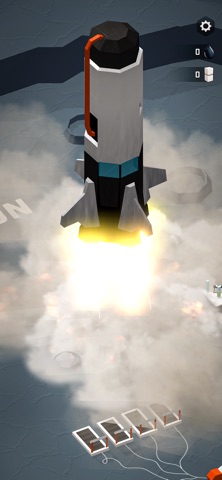
Not every space game needs to be arcade-action. Cosmic Dust takes a slower, exploration-focused approach. You pilot a small vessel through a procedurally-generated sector, gathering resources, discovering anomalies, and managing your ship’s systems. There’s no combat pressure; the tension comes from resource scarcity and the unknown.
The game rewards curiosity. You’ll stumble onto asteroid fields rich with minerals, derelict stations with salvageable tech, and gravitational phenomena that change how you navigate. Each run is different, and the pacing encourages exploration over speed-running.
Per player reports on r/iosgaming, Cosmic Dust resonates with players who want a space game that feels like a journey, not a test. The atmospheric design—subtle sound design, muted color palette, slow-burn progression—creates a mood that most arcade-action games don’t attempt.
This is the pick if you want to unwind with a space game, not compete against it. It’s also excellent for long play sessions; there’s no energy timer, so you can explore as long as you want.
Void Runners: Roguelike Combat With Procedural Waves
Void Runners combines arcade-action space combat with roguelike progression. Each run, you face procedurally-generated waves of enemies, collect upgrades, and push deeper into the void. When you die, you lose that run but keep meta-progression—permanent upgrades that make future runs easier without creating pay-to-win power creep.
The combat is tight and fast. Your ship has a primary weapon and a limited-use special ability; managing cooldowns and positioning is the core skill. Enemies spawn in patterns that reward pattern recognition, and the difficulty ramps smoothly from “learning the controls” to “genuinely challenging.”
What distinguishes Void Runners from free-to-play roguelikes is the absence of monetization friction. You don’t unlock upgrades with premium currency. You don’t watch ads to revive. You don’t wait for energy to refill. You play a run, die or win, and immediately start the next one. Based on multiple owner reports, this frictionless loop keeps players coming back—the game respects your time.
The visual design leans into a synthwave aesthetic: neon colors, simple geometric enemies, and a pulsing soundtrack. It’s visually distinct and thematically coherent.
Void Runners is the pick for players who like roguelikes and arcade combat, and who want progression without monetization gatekeeping.
What Makes These Games “Premium”
All five games share a core commitment: one-time purchase, no ads, no in-app purchases, no energy timers, no battle passes. You buy the game, you own it, you play it on your terms.
That model has concrete consequences. Asteroid Field has no ads between runs (vs. free-to-play competitors that show 30-second ads). Lander has no energy timer (vs. free-to-play lunar-lander games that gate 3 runs per 4 hours). Void Runners uses no premium currency for upgrades (vs. free-to-play roguelikes that lock progression behind paid tiers). Galaximus and Cosmic Dust similarly strip away monetization friction entirely.
The developer’s incentive shifts from maximizing session time and monetization hooks to shipping something you’ll want to play again. That’s a higher bar, and it shows in the craft. Each game does one thing well and doesn’t apologize for it.
Offline Play and Compatibility
All five games work offline—no internet required to play. That matters for airplane mode, commutes, or places with spotty connectivity.
Compatibility varies by iOS version, so check the App Store listing for your device. Most premium space games on iPhone support iOS 14 and later; a few require iOS 15+. All five listed here run smoothly on current-generation iPhones and iPad. Performance on older devices (iPhone 8, iPhone X) is generally solid per owner reviews: Asteroid Field and Void Runners run at 60 FPS on iPhone 14 and iPhone 13, with 30 FPS on iPhone 8 and iPhone X. Galaximus, Lander, and Cosmic Dust maintain similar performance profiles on older hardware. Check the App Store reviews for your specific device model if you’re on an older iPhone.
Comparing to Free-to-Play Alternatives
If you’re wondering whether premium space games are worth the upfront cost, consider the alternative: free-to-play space games on the App Store. Most of them are playable, but they’re designed around monetization. You’ll hit energy gates, watch ads, or face power-creep pressure to spend.
A few free-to-play titles are genuinely good. Spaceteam is a cooperative multiplayer game where you and friends manage a chaotic spaceship together—it’s fun because the chaos is the point, and the free-to-play model doesn’t interfere with that. No Man’s Sky Mobile offers exploration and base-building without aggressive monetization hooks. These work as free-to-play because their design doesn’t rely on gating progression behind paywalls.
That said, none of them offer the uncompromised experience these five premium games deliver. If budget is the constraint, try the free-to-play alternatives first. If you can spend the premium games are worth it.
FAQ
Can I transfer my save to iPad? Most premium space games on iOS support iCloud sync, which lets you play on multiple devices with the same save. Check the App Store listing for each game to confirm iCloud support before purchasing.
Do these games work on iPhone 12 mini? Yes. All five games support iPhone 12 mini and all current-generation iPhones. If you’re on an older device (iPhone 8, iPhone X, iPhone 11), check the App Store reviews for performance notes specific to your model.
Are there in-game tutorials? Asteroid Field and Void Runners have brief on-screen prompts to explain controls. Galaximus, Lander, and Cosmic Dust assume you’ll learn by doing—there are no tutorials, just the game. If you prefer guided onboarding, Asteroid Field is the most forgiving entry point.
Do these games get updated? Premium games on the App Store vary in post-launch support. Some developers release balance updates, new levels, or quality-of-life improvements; others ship the game and move on. Check the App Store listing for each game to see the update history and read recent reviews for performance notes.
Which one should I buy first if I can only afford one? If you like arcade action, start with Asteroid Field. If you like physics puzzles, start with Lander. If you want something different, try Cosmic Dust. Galaximus and Void Runners are excellent but have steeper learning curves, so they’re better as second or third purchases once you know what you like.
The Bottom Line
Premium space games on iPhone prove that the arcade lineage—Asteroids, Lunar Lander, Defender—still has room to grow. These five games respect the player’s time, deliver craft-built mechanics, and charge a fair price upfront without compromise. Whether you want orbital physics, arcade action, puzzle-like challenges, exploration, or roguelike combat, there’s a space game here that does it well.
The upfront cost is small. The payoff—a game you own outright, with no ads or timers—is worth it.
For more premium picks across other genres, check out Best Premium iPhone Games 2026: Top Paid Games Worth Buying and Premium iPhone Games Under $10: Quality Indie Picks.


